
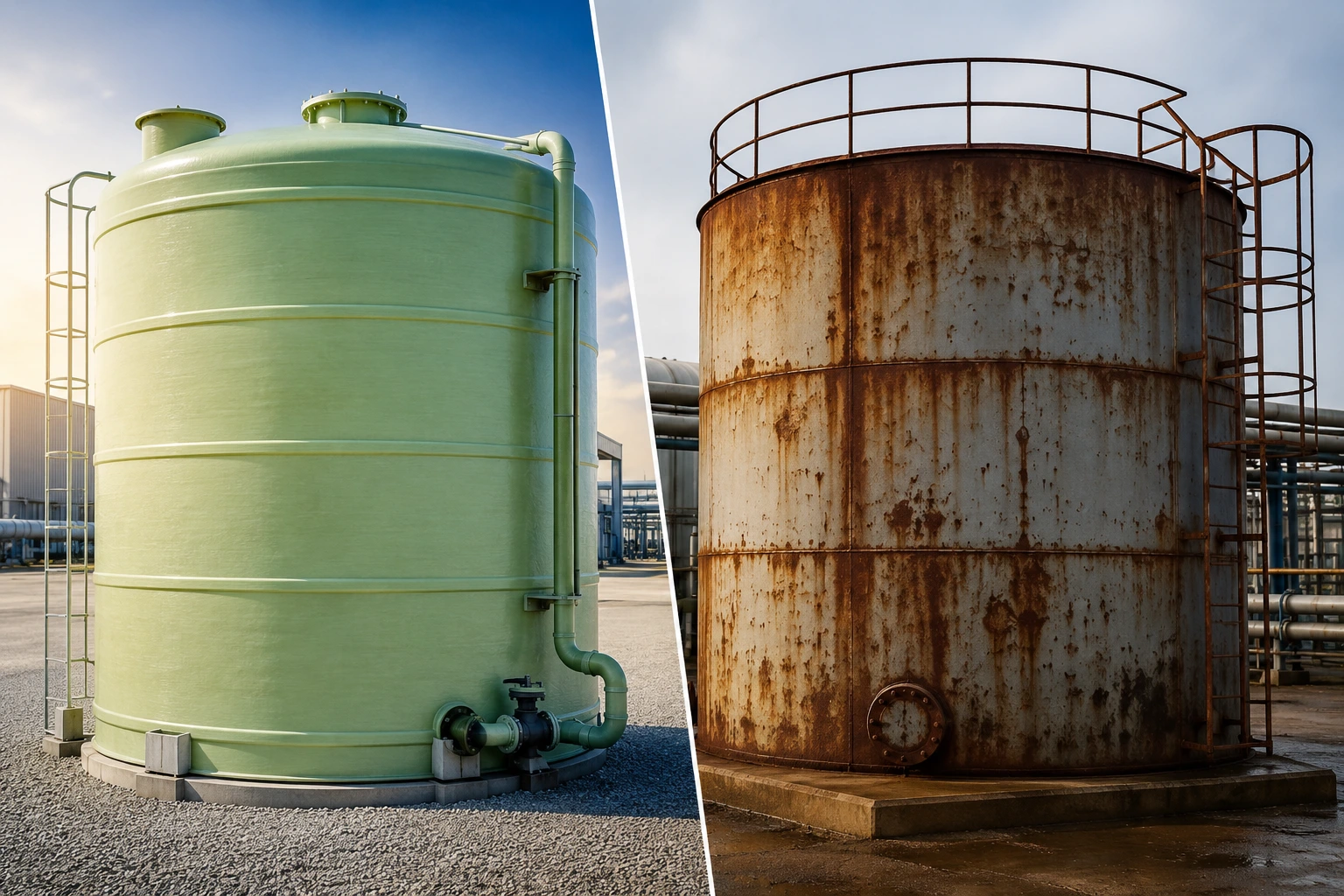
FRP vs Steel Tanks: Which Offers the Lowest Total Storage Tank Cost?
If you are about to buy a storage tank, you have probably asked yourself one simple question: should I go with FRP or steel? It’s a fair worry, because nobody wants to spend money twice on the same problem. When people compare FRP vs steel tanks, they usually look only at the price tag on day one. But the real storage tank cost shows up months and years later, in repairs, rust removal, and replacements. This article breaks down the full ownership cost so you can choose with confidence, not guesswork.
Understanding Total Cost of Ownership (TCO)
Total Cost of Ownership (TCO) is the complete amount you spend on a tank from purchase to replacement, not just the buying price.
It includes:
- Initial purchase price
- Installation and transportation
- Routine maintenance
- Repairs and downtime
- Corrosion protection
- Energy used in operation
- Inspection costs
- Eventual replacement
When you compare FRP vs steel tanks using TCO instead of sticker price, the picture often changes completely. A tank that looked cheaper at purchase can quietly become the more expensive option within a few years.
Initial Purchase Cost: FRP vs Steel Tanks
Carbon steel tanks usually cost less to buy than FRP tanks at first glance, while stainless steel sits at the top of the price range.
FRP tanks are factory molded, which keeps fabrication simple and consistent.
Businesses looking for durable fiberglass water tanks often find that faster installation helps reduce overall project costs.
Steel tanks need welding, which adds labor hours and raises the final bill, especially for stainless steel.
| Factor | FRP | Steel |
| Material Cost | Moderate to high | Low (carbon) / High (stainless) |
| Fabrication | Factory molded, simpler | Welding required, labor heavy |
| Transportation | Lightweight, cheaper to move | Heavier, costlier logistics |
| Installation | Faster, fewer crew needed | Slower, more equipment needed |
This is one reason storage tank cost discussions can be misleading if you stop at this table alone.
Maintenance Costs Over Time
Steel tanks need ongoing maintenance to fight rust, while FRP tanks need very little upkeep.
Steel tank owners usually deal with:
- Rust formation
- Repainting every few years
- Protective coatings
- Welding repairs
- Regular corrosion inspection
FRP tank owners benefit from:
- No rust, since fiberglass does not corrode
- A UV-resistant gel coat that protects the surface
- No repainting needed
- Minimal routine maintenance
This corrosion resistance is one of the biggest reasons many tanks reach their expected service life without expensive structural repairs. Learn more about the common causes of tank damage in our guide on Fiberglass Tank Failure Reasons.
| Maintenance Item | FRP | Steel |
| Rust Treatment | Not needed | Needed regularly |
| Repainting | Not needed | Every 3-5 years |
| Coating Renewal | Rare | Frequent |
| Annual Maintenance Cost | Low | Medium to High |
Lifespan Comparison
FRP tanks typically last 25 to 40 years or more, while steel tank lifespan depends heavily on maintenance and local climate.
FRP resists both corrosion and chemical exposure, which helps it last decades without major damage. Steel tanks, especially in coastal or humid regions, can deteriorate much faster if maintenance is skipped even for a short period.
| Tank Type | Typical Lifespan | Main Risk Factor |
| FRP | 25-40+ years | Minimal, rare physical damage |
| Carbon Steel | 10-20 years | Corrosion, weather exposure |
| Stainless Steel | 20-30 years | Cost of upkeep, welding seams |
Saudi Arabia’s heat and humidity in coastal cities make this lifespan gap even wider in real-world conditions.
We explain these environmental effects in more detail in How Long Do FRP Water Tanks Last in Saudi Climate?
Hidden Costs Most Buyers Overlook
Many buyers forget to count the indirect costs that pile up after installation, and these often decide the true storage tank cost.
These hidden expenses include:
- Painting and repainting labor
- Rust removal equipment and time
- Chemical lining replacement
- Downtime while repairs happen
- Product contamination from rust particles
- Water loss through leaks
- Extra labor for emergency fixes
A tank that sits idle for repairs is not just costing money on parts. It is also costing you production time, which matters a lot for water treatment plants and chemical facilities working on tight schedules. Choosing the right storage solution from the beginning can significantly reduce these expenses, especially for large infrastructure projects. Our article on Best Water Storage Solutions for Construction Projects explains why.
Cost Comparison by Industry
Different industries get different value from FRP and steel, depending on what they store.
| Industry | Better Option | Why |
| Water Storage | FRP | No rust, safe for drinking water |
| Chemical Plants | FRP | Strong chemical resistance |
| Agriculture | FRP | Low maintenance, long lifespan |
| Fire Water Storage | FRP | Durable, corrosion-free over decades |
| Oil & Gas | Depends | Based on temperature and pressure needs |
FRP vs Steel Tanks Comparison Table
| Feature | FRP | Steel |
| Initial Cost | Moderate | Low (carbon) / High (stainless) |
| Maintenance | Very low | Medium to high |
| Lifespan | 25-40+ years | 10-30 years |
| Corrosion | Resistant | Vulnerable (carbon) |
| UV Resistance | Strong | Needs coating |
| Chemical Resistance | Strong | Limited |
| Repair Frequency | Rare | Frequent |
| Total Ownership Cost | Lower over time | Higher over time |
Which Tank Offers Better Long-Term Value?
FRP tanks generally offer better long-term value for buyers in Saudi Arabia because they handle heat, humidity, and chemical exposure without breaking down.
FRP is the stronger choice for:
- Coastal regions with high humidity
- Water storage for homes and facilities
- Chemical storage tanks
- Operations that want low maintenance
Steel still makes sense in specific cases, such as:
- Very high mechanical load requirements
- High-temperature industrial applications
- Sites with existing steel infrastructure that needs matching parts
When you weigh FRP vs steel tanks honestly, the decision usually comes down to how long you plan to keep the tank in service. For long-term use, FRP tends to protect your budget better.
Conclusion
Comparing only the purchase price can lead to a costly mistake. Carbon steel tanks may look cheaper on day one, but maintenance, corrosion protection, repairs, and a shorter lifespan often push the total storage tank cost higher over time. When you study FRP vs steel tanks side by side, FRP usually wins on total ownership cost, especially in Saudi Arabia’s harsh climate. Before making a final decision, you can also explore our latest projects and customer reviews on our Google Business Profile. If you want a tank built to last with minimal upkeep, it’s worth getting a proper quote tailored to your project before you decide.
FAQs
Is FRP cheaper than steel tanks?
FRP often costs more than carbon steel upfront but less than stainless steel. Over the tank’s full lifespan, FRP usually costs less due to lower maintenance, no rust treatment, and fewer repairs, making FRP vs steel tanks a closer call than the initial price suggests.
Which tank lasts longer in Saudi Arabia?
FRP tanks generally last longer in Saudi Arabia, often 25 to 40 years, because they resist heat, humidity, and corrosion. Steel tanks, especially carbon steel, tend to deteriorate faster in coastal and humid regions without strict maintenance.
Are FRP tanks maintenance-free?
FRP tanks are not completely maintenance-free, but they need far less upkeep than steel. They do not rust, do not need repainting, and rarely require coating renewal, which keeps long-term storage tank cost low.
What affects storage tank cost the most?
Storage tank cost is affected most by material type, maintenance needs, corrosion protection, lifespan, and repair frequency. Purchase price alone rarely reflects the true cost, since steel often needs more ongoing care than FRP.
Can FRP tanks replace steel tanks?
Yes, FRP tanks can replace steel tanks in most water, chemical, and agricultural storage applications. Steel may still be preferred for high-temperature or high-pressure industrial uses where mechanical strength is the top priority.
Which tank is better for chemical storage?
FRP tanks are generally better for chemical storage because fiberglass resists a wide range of chemicals without corroding. This makes FRP a safer and more cost-effective long-term choice for chemical plants.