
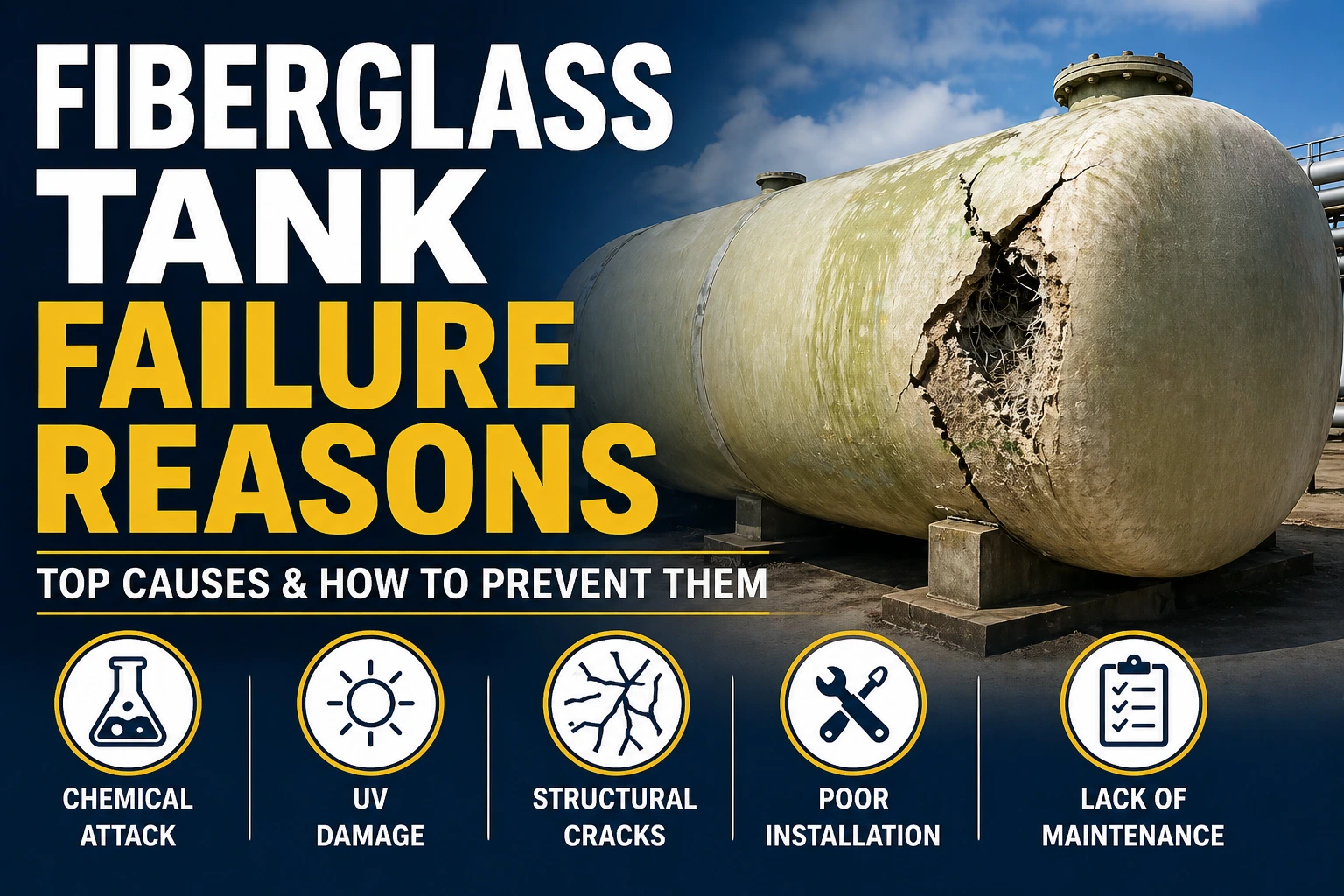
Fiberglass Tank Failure Reasons: What Causes Early Failure and How to Avoid It
The most common fiberglass tank failure reasons are wrong resin selection, UV damage, manufacturing defects, and zero maintenance. Most tanks do not fail because fiberglass is weak – they fail because of poor decisions made before and after installation.
You bought a fiberglass tank expecting 20 years of service. Five years in, it is leaking. That is not bad luck – it is a predictable outcome of a few known engineering mistakes. This blog walks you through every major failure cause, backed by field data, so you can avoid an expensive repeat.
The Real Problem: Why Most Fiberglass Tanks Fail in 3–7 Years (Not 20)
Fiberglass Reinforced Plastic (FRP) is genuinely strong. Under the right conditions, it holds up for 20–25 years. But most tanks never reach that mark. The reason is not the material – it is a chain of small, avoidable errors in resin choice, manufacturing, and site work that compound over time and destroy structural integrity.
Failure is not random. Every crack, leak, and bulge has a traceable cause. Once you understand those causes, you can stop them.
The FRP Failure Risk Index (FFRI): How to Predict Your Tank’s Lifespan
Score your tank across five factors (1 = poor, 5 = excellent). Add the numbers to see where you stand.
| Factor | What to Score |
| Material Selection | Is the resin matched to the stored chemical? |
| Manufacturing Quality | Consistent lamination, no air voids |
| Installation Accuracy | Level foundation, proper anchoring |
| Environmental Exposure | UV, temperature swings, chemical fumes |
| Maintenance Frequency | Annual inspection + protective coatings |
Score Results:
- 5–10 → High risk – fails within 5 years
- 10–18 → Moderate risk – 5–12 year lifespan
- 18–25 → Low risk – 15–25 year lifespan
Scoring adapted from ASTM D3299 structural compliance framework and industry root cause analysis reports.
Top 7 Fiberglass Tank Failure Reasons (Ranked by Field Data)
These are not theoretical problems. They show up repeatedly in failure analysis reports from industrial tank inspections across India, the UAE, and Saudi Arabia.
1. Wrong Resin Selection (Chemical Incompatibility)
Using orthophthalic resin to store aggressive chemicals – when the job requires vinyl ester or isophthalic resin – is the single biggest fiberglass tank failure reason in industrial settings. The stored liquid slowly permeates the laminate, causes micro-cracks, and leads to delamination. Resin selection must be matched to the exact chemical and its concentration before fabrication begins – this is fully explained in our guide on chemical resistance of FRP tanks.
2. UV Degradation and Photo-Oxidation
In outdoor installations across Kerala, Tamil Nadu, and Gulf states, direct sunlight breaks down the resin matrix over time. The surface chalks, the glass fibers come exposed, and tensile strength drops steadily. Without a UV-resistant gel coat or protective coating, this process starts in under two years. FRP tank cracking causes often trace back to UV damage that was never addressed early on.
3. Structural Design Errors (Wrong Wall Thickness)
Wall thickness must be calculated based on hydrostatic pressure and hoop stress for the actual stored volume and fluid density. Undersized walls flex under load, generate fatigue cracks, and eventually fail. A tank designed “by eye” rather than by engineering calculation is a liability, not an asset.
4. Manufacturing Defects – Air Voids and Dry Fibers
In hand lay-up and filament winding processes, poor workmanship leaves air pockets and dry fiber patches inside the laminate. These weak zones become the starting points for cracks under pressure. This is one of the hardest defects to detect after purchase – which is why ASTM-compliant quality checks during fabrication matter so much.
5. Improper Installation – Foundation and Anchoring Failures
An uneven base creates unequal load distribution. Over months, this causes settlement-induced stress at the tank’s lower shell. Without proper anchoring, wind and seismic activity add lateral loads the tank was not designed to handle. These are among the most common fiberglass tank failure reasons seen in field inspections – and entirely preventable with a proper civil base.
6. Thermal Stress and Expansion Cycles
Tanks in regions with wide day-night temperature swings – like Rajasthan, central Saudi Arabia, or industrial areas near furnaces – undergo daily expansion and contraction. Over years, this causes creep deformation, joint fatigue, and cracking at fittings. Thermal expansion must be accounted for in both design and installation.
7. No Preventive Maintenance
A hairline crack is a warning. Left alone, it becomes a full leak. Without a structured inspection plan, small defects escalate quickly—follow a proven fiberglass tank maintenance checklist to prevent early failure. Lifecycle management is not optional – it is what separates a 5-year tank from a 20-year one. This is the most straightforward of all why FRP tanks fail reasons to fix, yet it is the most often ignored.
Engineering Standards That Prevent FRP Tank Failure
Most buyers never ask about compliance – and most failures happen in tanks that were never built to a recognized standard. Knowing these standards protects you.
- ASTM D3299 – Filament-wound glass-fiber-reinforced thermoset resin tanks. Covers design, materials, and fabrication requirements.
You can review the full requirements under the official ASTM D3299 standard specification to understand how compliant tanks are designed and manufactured. - ASTM D4097 – Contact-molded glass-fiber-reinforced thermoset resin tanks. Applies to hand lay-up production.
- ISO 14692 – GRP piping and fittings for petroleum and natural gas industries.
- American Water Works Association (AWWA) C950 – Fiberglass pipe for water supply.
A tank built without any of these benchmarks gives you no engineering guarantee. Non-compliance is a documented early fiberglass tank failure reason in industrial root cause analyses.
Environmental Risk Factors: Why Location Changes FRP Lifespan
Where your tank is installed directly affects how fast it ages. Geography is a hidden variable in every tank lifespan calculation.
- Kerala and coastal South India: High humidity and monsoon chemical exposure accelerate surface degradation and osmotic blistering.
- Saudi Arabia and UAE: UV intensity and ambient temperatures above 45°C put constant thermal and photo-oxidation stress on the resin matrix.
- Industrial zones near Chennai or Mumbai: Airborne chemical fumes and acid rain create an additional corrosion layer not accounted for in standard design.
Tanks in these zones need region-specific resin selection, UV-rated gel coats, and more frequent inspections than baseline recommendations.
FRP vs Other Tank Materials: Failure Risk Comparison
Before choosing a tank material, it helps to understand what each one fails from and how fast that failure typically comes.
| Material | Primary Failure Mode | Maintenance Needs | Lifespan Risk |
| FRP (Fiberglass) | UV, wrong resin, poor installation | Low – if designed correctly | Low with compliance |
| Carbon Steel | Rust, internal corrosion | High – regular coating | High in chemical/wet use |
| HDPE | Creep deformation, UV cracking | Low | Medium |
| Reinforced Concrete | Rebar corrosion, chemical attack | High | High in acidic environments |
FRP remains the most cost-efficient long-term option – but only when fabricated and installed correctly.
Why One FRP Tank Lasts 20 Years and Another Fails in 5
Here is a direct comparison of two real-world tank setups with identical fiberglass material but completely different outcomes. The differences come down to engineering decisions, not luck.
| Parameter | Tank A – 20-Year Lifespan | Tank B – Failed in 5 Years |
| Resin Type | Vinyl ester (chemical-grade) | Orthophthalic (general purpose) |
| UV Protection | UV-resistant gel coat applied | None |
| Annual Inspection | Yes – documented | None |
| Foundation | Level concrete pad, anchored | Uneven gravel, no anchoring |
| ASTM Compliance | ASTM D3299 certified | No standard referenced |
| Outcome | Still in service | Structural leak, replaced |
Warning Signs Your Fiberglass Tank Is About to Fail
Act on these early. Every one of these signals points to material degradation or structural fatigue that gets worse if ignored.
- Surface cracks or crazing – fine network of cracks across the surface, often near fittings or base joints
- Chalky or white discoloration – UV degradation is consuming the resin layer
- Visible fiber texture – resin layer has worn away, leaving glass fibers exposed
- Bulging or deformed walls – internal pressure is exceeding the design limit
- Seepage or staining – liquid is already moving through the laminate
How to Prevent Fiberglass Tank Failure (Engineering Checklist)
Prevention starts at design, not after installation. Work through this phase-by-phase list before your next tank purchase or installation.
Design Phase
- Specify resin type based on stored chemical and concentration
- Calculate wall thickness using hydrostatic pressure and hoop stress formulas
- Run Finite Element Analysis for tanks above 10,000 litres capacity
- Confirm ASTM D3299 or D4097 compliance in the fabrication scope
Installation Phase
- Pour a level, reinforced concrete foundation sized for full tank weight
- Anchor the tank to resist wind and seismic lateral loads
- Use flexible couplings at pipe entry points to absorb thermal movement
Maintenance Phase
- Inspect annually – document condition, measure wall thickness
- Reapply UV-resistant coatings every 3–5 years in high-UV regions
- Check fittings and nozzles for weeping or discoloration every 6 months
Buyer’s Checklist: How to Choose an FRP Tank That Won’t Fail Early
Before signing a purchase order, ask these questions. A manufacturer that cannot answer them clearly is a risk you do not need.
- What resin type is used, and how was it matched to my stored chemical?
- Does the tank comply with ASTM D3299 or D4097? Can you provide the test certificate?
- What is the specified wall thickness, and how was it calculated?
- What warranty do you offer against manufacturing defects – and what does it cover?
- Is a UV-resistant gel coat included as standard, or is it an extra cost?
Cost of Failure: Why Cheap FRP Tanks Become Expensive Mistakes
The price difference between a well-built tank and a low-cost one looks small at purchase. It looks very different three years later.
- Emergency repair: ₹80,000–₹3,00,000
- Production downtime: Days to weeks of lost output
- Full tank replacement: 2–4× the original purchase cost
- Environmental liability: Cleanup costs plus regulatory fines
Every rupee saved on a non-compliant tank trades against a much larger bill later. Spending right the first time is the only financially rational choice.
Expert Takeaway: FRP Tank Failure Is Predictable – Not Random
After working with FRP tank failures across industrial projects in India and the Middle East, the same patterns show up again and again. Incorrect resin. No UV protection. Ignored cracks. These are not accidents – they are decisions. And decisions can be changed.
The tanks that last 20 years are not made from better fiberglass. They are specified better, built to a standard, installed on a proper base, and inspected once a year. That is the entire difference.
FAQ
What is the most common cause of fiberglass tank failure?
Incorrect resin selection combined with poor installation accounts for the majority of premature failures. Using the wrong resin for the stored chemical causes permeation, micro-cracking, and delamination within a few years.
How long should a fiberglass (FRP) tank last?
A tank manufactured to ASTM D3299 standards, installed on a proper foundation, and maintained annually should last 15–25 years. Tanks built without a recognized standard often fail before 7 years.
Can fiberglass tanks crack easily?
Not under normal design conditions. FRP tank cracking causes are almost always linked to UV degradation, thermal stress cycling, poor installation, or undersized wall thickness – not the material itself.
How do you maintain a fiberglass tank?
Annual visual inspections, UV coating reapplication every 3–5 years, and fitting checks every six months cover most maintenance needs. Keep a written log – documented inspections also protect your warranty claims.
Why do FRP tanks fail faster in hot climates like Kerala or UAE?
High UV intensity, humidity, and temperature cycling accelerate both photo-oxidation and thermal fatigue. Tanks in these regions need region-specific resin and more frequent UV coating refreshes to maintain design lifespan.
Stop Treating FRP Tank Failure as “Normal”
No tank has to fail in 5 years. The fiberglass tank failure reasons covered here – wrong resin, UV neglect, poor installation, and zero maintenance – are all knowable and fixable before they become a problem. The money you lose replacing a failed tank, cleaning up a spill, or shutting down a production line is always more than what a properly specified tank would have cost.
If you are evaluating FRP tanks for a new project or replacing a failed one, Al Ragheedd Fiberglass builds to ASTM standards with documented engineering behind every unit. Talk to the team before you buy – not after.