
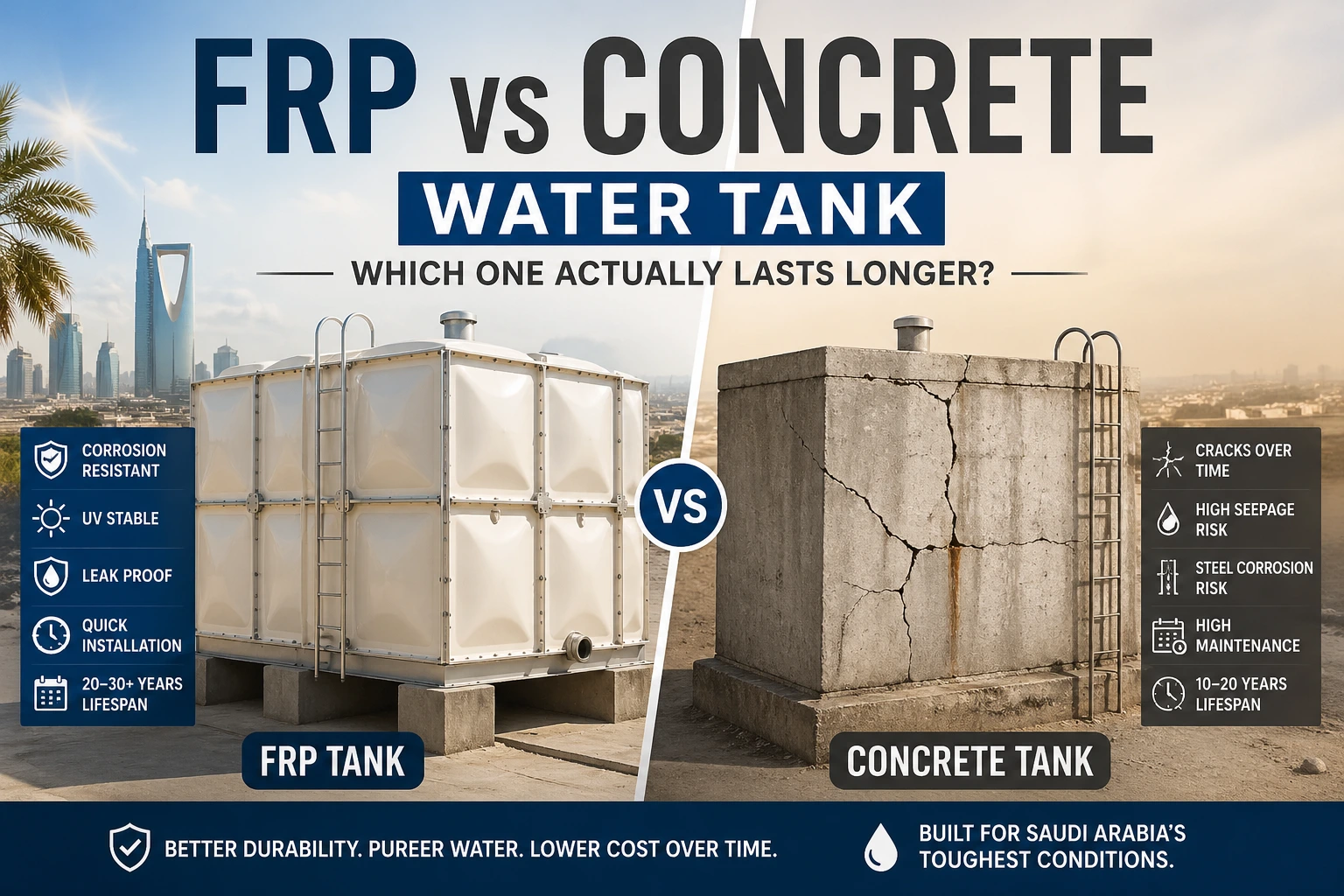
FRP vs Concrete Water Tank in Saudi Arabia: Which One Actually Lasts Longer?
You built a tank. You spent good money. Three years later, you’re watching a crack spread across the wall like a slow disaster you can’t stop.
This happens more than people admit in Saudi Arabia. And it almost always comes down to one decision made at the beginning – the wrong material.
The FRP vs concrete water tank question is not a technical debate for engineers only. It is a real choice that affects your water quality, your budget, and your peace of mind for the next 20 years. So let’s talk about it honestly.
What Are You Actually Buying?
Most people see a tank as just a box that holds water. It is not. It is a structure that fights heat, UV radiation, chemical pressure, and daily expansion cycles – every single day, for decades. In Saudi Arabia, that fight is harder than almost anywhere else in the world.
The FRP Water Tank
FRP – Fiberglass Reinforced Plastic – is a composite of glass fibres bonded with resin. Polyester, epoxy, or vinyl ester resin systems are used depending on the application. The outer surface carries an anti-UV gel coat that blocks radiation from degrading the material underneath.
What makes FRP different is what it does not do. It does not absorb water. It does not corrode. It does not crack under heat cycling the way brittle materials do. The thermal expansion coefficient is low, which means temperature swings cause far less structural stress compared to concrete.
It is modular – panels arrive on-site and go up in days, not weeks.
→ Learn more about FRP tanks and available configurations.
The Concrete Tank
Reinforced concrete uses cement, sand, aggregate, and steel bars. Cast on-site, it needs 7 to 28 days of curing. After that, waterproofing is applied – because concrete, by its very nature, is porous.
Here is what most salespeople won’t tell you: the performance of a concrete tank depends almost entirely on how well it was built. The curing conditions, the waterproofing quality, the skill of the labour. Get any one of those wrong, and you have already set the clock ticking on failure.
What Saudi Arabia Does to These Materials
Surface temperatures in Saudi Arabia regularly exceed 60°C in summer. The air temperature in Riyadh, Dammam, Makkah, and Tabuk crosses 45–50°C for months. Every morning the material heats up. Every night it cools down. That cycle repeats 365 days a year.
For concrete, that is a slow death sentence.
Each expansion-contraction cycle pulls at the material. Tiny cracks form – invisible at first. Then water finds those cracks. Water reaches the steel reinforcement inside. Steel rusts. And here is the part that surprises most people: corroding steel expands to 6–10 times its original volume. It does not just weaken – it pushes. It cracks the concrete from the inside out.
UV radiation adds another layer of damage. Concrete has no defence against it. The surface erodes, weakens, and becomes even more vulnerable to moisture.
FRP behaves differently under the same conditions. The UV gel coat handles radiation directly. The low expansion rate means heat cycles create far less internal stress. The non-porous structure gives water no entry point at all.
A Story Worth Knowing
A residential project in Riyadh built a reinforced concrete water tank. Solid construction, good waterproofing at the start. Within six years, seepage appeared at the base. By year nine, two wall sections showed visible cracking – the steel reinforcement inside had corroded and pushed through.
Repairs cost the owner roughly 45% of what the original tank cost to build. By year fourteen, they replaced it completely.
That is not a rare story. That is a pattern.
The Numbers That Matter
| Factor | FRP Tank | Concrete Tank |
| Expected Lifespan | 20–30+ years | 10–20 years |
| UV Resistance | Built-in gel coat | None |
| Seepage Risk | Zero – non-porous | High over time |
| Heat Crack Risk | Low | High |
| Steel Corrosion | Not applicable | Serious risk |
| Installation Time | 1–3 days | 7–28 days curing |
| 15-Year Maintenance Cost | Low | 40–70% higher |
When you look at concrete vs FRP durability this way, the upfront saving on concrete starts to look much smaller. Over 10–15 years, the repair bills, waterproofing renewal, downtime, and eventual replacement make concrete the more expensive option – not the cheaper one.
Hygiene Is Not a Small Thing
The American Water Works Association (AWWA) is clear on this: the material your storage tank is made from directly affects the water inside it.
Concrete develops micro-cracks. Moisture sits in those cracks. Over time, that becomes a microbial environment. Lime from the cement can leach into water and alter its pH. For drinking water, hospitals, hotels, or food production, this is not an acceptable risk.
FRP has a smooth, non-reactive inner surface. Nothing grows on it. Nothing leaches from it. The water that goes in comes out the same.
Over 10–15 years, the repair bills and upkeep add up significantly.
→ Follow these maintenance tips to extend tank life and avoid failures.
The material your storage tank is made from directly affects water quality, as defined by AWWA standards.
When Each Option Makes Sense
Choose FRP when:
- Your project is in any major Saudi city – heat exposure is consistent and severe
- Water quality standards are non-negotiable
- You want the installation done fast, without a month of curing delays
- You are thinking 15–20 years ahead, not just the first year
Concrete might still work when:
- You are in a remote location where prefabricated panels cannot be transported easily
- The tank will be fully underground with high-quality waterproofing applied
- It is a short-term or low-priority installation
What Saudi Standards Say
The Saudi Standards, Metrology and Quality Organization (SASO) sets the compliance requirements for water storage in the Kingdom. Quality FRP panel tanks – like those produced by Al Ragheedh Fiberglass – are manufactured to meet SASO requirements alongside AWWA standards.
The fiberglass tank lifespan in Saudi Arabia is not a guess or a marketing claim. It is the result of material science meeting one of the harshest climates on earth – and holding up.
The Honest Verdict
Nobody wants to rebuild a tank they just paid for. Nobody wants to explain to a client why water quality failed, or why a wall cracked open three years after construction.
The FRP vs concrete water tank decision in Saudi Arabia is not close when you look at it fully. FRP lasts longer, performs better in heat, protects water quality, and costs less over time. Concrete has one advantage – a lower price tag on day one. That advantage disappears fast.
Build it right the first time. In Saudi Arabia’s climate, that means choosing the material that was designed to survive it.
Al Ragheedh Fiberglass supplies SASO-compliant FRP panel water tanks for residential, commercial, and industrial projects across Saudi Arabia. View options →
FAQ
Does the FRP vs concrete water tank cost difference justify switching?
Yes – when you calculate over 10–15 years. Concrete costs less upfront. FRP costs significantly less over the life of the structure.
What is the actual fiberglass tank lifespan in Saudi conditions?
20–30+ years with standard maintenance. Concrete tanks in the same region show serious degradation in 10–15 years on average.
Can FRP tanks be built large enough for industrial or municipal use?
Yes. The modular panel system means tanks can be scaled to almost any capacity required – from rooftop residential units to large industrial storage.