
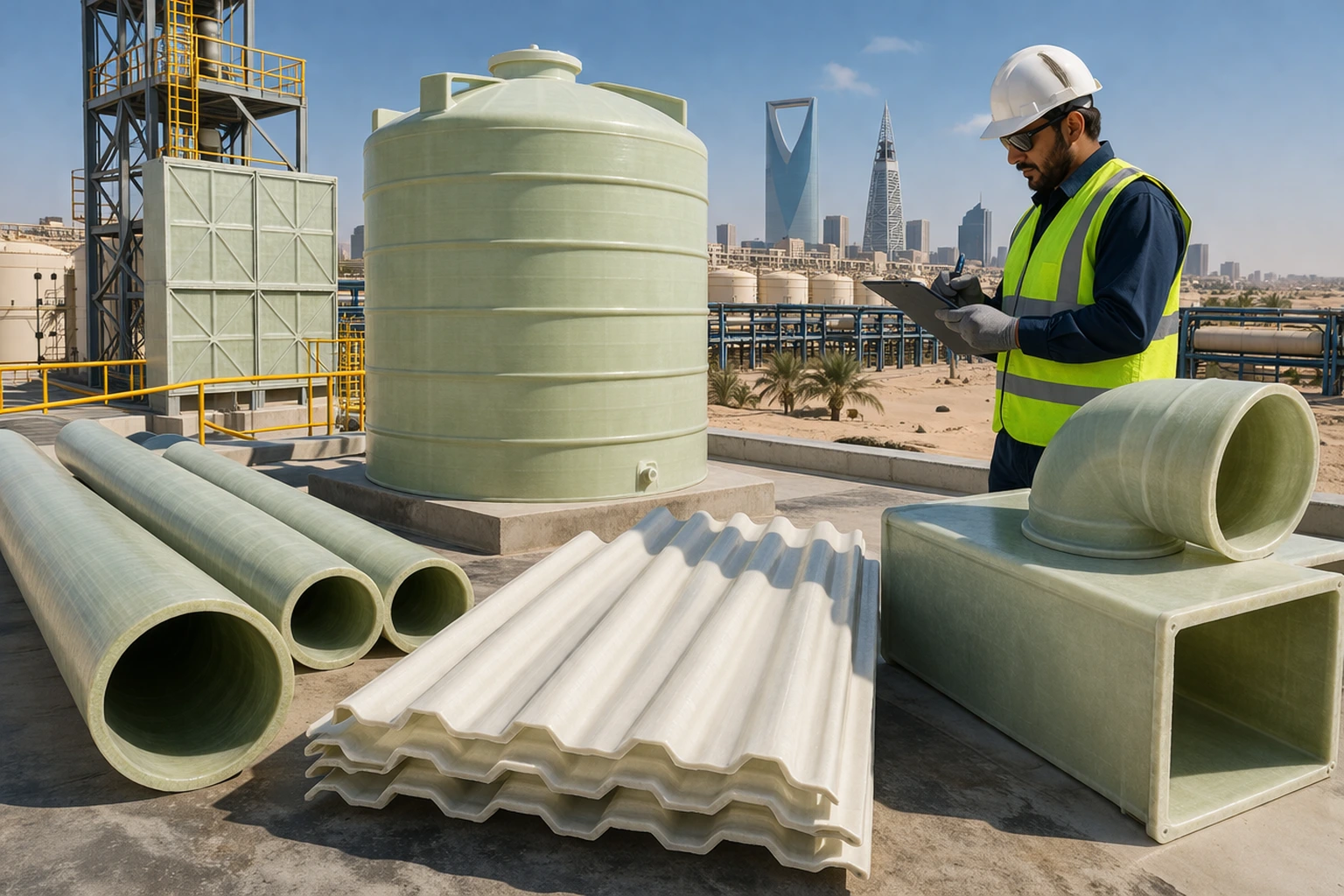
FRP Products Checklist for Construction Projects in Saudi Arabia
Nobody warns you about this when you start a construction project in Saudi Arabia.
You pick your materials, place the order, and six months into the job, things start going wrong. A pipe joint leaks. A storage tank shows stress lines. A ducting section warps. You go back to the quote sheet and realise – you picked the wrong product for the wrong conditions.
FRP products fix exactly this problem. But only when you know what to check before buying.
This checklist covers the full picture – selection, installation, maintenance, and inspection – written specifically for construction in Saudi Arabia’s harsh environment.
What FRP Actually Is And Why It Matters Here
FRP stands for Fiber Reinforced Plastic. It combines glass fibers with a resin – usually polyester, isophthalic, or vinyl ester – to produce something that steel and standard plastic simply cannot match in this climate.
It does not rust. It handles heat above 45°C. Coastal salt air from Jeddah or Dammam does not touch it. UV exposure that destroys ordinary plastic barely affects it when a proper gelcoat layer is applied.
The American Water Works Association (AWWA) confirms that non-corrosive composite materials measurably improve durability and cut long-term maintenance costs in water infrastructure. The World Bank (2022) specifically flagged the Gulf region’s extreme climate as a key reason why standard materials fail faster here than almost anywhere else.
That context matters. It tells you this is not a marketing claim – it is a documented engineering reality.
The FRP Products Checklist
Work through each category against your project type. Do not skip sections that seem irrelevant – they often contain the detail that prevents a failure six months down the line.
FRP Water Tanks
- Confirm resin type: isophthalic or vinyl ester for potable water, standard polyester for irrigation or industrial use
- Verify NSF/ANSI 61 certification if the tank will store drinking water
- Check wall thickness against storage volume and load – do not estimate this
- Confirm UV-resistant gelcoat on the outer shell – essential for outdoor placement in Saudi Arabia
- Expected service life: 20–25 years when properly maintained
FRP tanks in Saudi Arabia handle everything from residential water supply to large industrial storage across Riyadh, Jeddah, and Dammam. Their combination of heat resistance and corrosion immunity makes them the most practical long-term choice for the region.
FRP Pipes
- Match resin type to the fluid: vinyl ester for chemicals, polyester for water and drainage
- Check pressure rating and pipe diameter against your system design
- Verify joint type: laminated butt-and-wrap joints outperform bell-and-spigot for underground use
- Standards to ask for: ASTM D2996 (filament-wound pipes), ISO 14692 (industrial pipeline systems)
FRP Roofing Sheets
- Confirm fire rating: Class A or Class C depending on the building type
- Thickness guide: 1.5mm for light structures, 2.5mm–3mm for industrial use
- UV-stabilised surface is non-negotiable for outdoor installations in Saudi Arabia
FRP Ducting Systems
- Check chemical resistance against what is being vented – a fume extraction duct for chemicals needs a different resin than a standard HVAC duct
- Confirm flange connection type matches your existing system
- Lightweight build cuts structural support costs significantly compared to steel alternatives
FRP Gratings and Walkway Platforms
- Choose molded gratings for higher chemical resistance, pultruded gratings for heavier load capacity
- Anti-slip surface finish is mandatory in any wet, oily, or exposed environment
- Verify load rating per square metre – this is the number most buyers forget to check
FRP Panels, Cable Trays, and Handrails
- Panels for electrical enclosures must use fire-retardant resin – this is a safety requirement, not optional
- For cable trays in petrochemical or power plant settings, pultruded FRP profiles are the standard replacement for steel
- Handrails must meet load and deflection standards for worker safety compliance
Installation: Where Most Projects Go Wrong
Bad installation ruins good material. These steps are worth following every time.
- Prepare a flat, compacted base before placing tanks or structural components
- Use manufacturer-approved fittings – generic fittings cause joint failures that are expensive to fix post-build
- Pressure-test pipe systems before backfilling or commissioning
- Follow cure time instructions exactly, especially when site temperatures are high
- Never drag or drop FRP products – impact damage to the gelcoat starts a deterioration process that is invisible until it becomes a serious problem
Maintenance and Inspection Checklist
FRP needs far less attention than steel, but skipping basic checks entirely is how a 25-year product ends up failing in ten.
Every 6 months:
- Check the outer surface for cracks, bubbling, or discoloration
- Inspect joints and fittings for leakage or stress marks
- Clean with mild soap and a soft brush – abrasive cleaners damage the surface layer
Every 2–3 years:
- Reapply UV-protective coating on surfaces in direct sunlight
- Inspect internal tank and pipe linings for thinning, pitting, or exposed fiber
Every 5 years:
- Commission a professional inspection using ultrasonic (NDT) testing to measure wall thickness and detect hidden delamination
- Document findings and compare against your baseline inspection records
If you see star cracks, delamination, fiber blooming, or deflection in walkway panels – act on it. These are not cosmetic issues. They are structural warnings.
Minor surface repairs: Clean the area, sand with 80-grit paper, apply compatible repair resin, add chopped strand mat if needed, cure fully, then restore the gelcoat. Any damage covering more than 5% of a component or involving through-wall cracks needs a qualified composite repair specialist – not a site workaround.
What to Check Before Buying From Any Supplier
- Ask for certified test reports for tensile strength, wall thickness, and resin type – not just a product brochure
- Confirm the supplier understands local Saudi Building Code (SBC) requirements
- Check their track record on comparable projects in the Kingdom
- Ask whether they offer post-delivery technical support and warranty documentation
Al Ragheedh has been supplying fiberglass solutions across Saudi Arabia for years, with products built around the specific demands of this climate. If you need project-specific guidance on selecting the right fiberglass water storage system or choosing industrial FRP components for your site, their team can help you get the specifications right before you order.
Conclusion
Construction projects in Saudi Arabia do not fail because of a lack of budget. They fail because of decisions made too quickly at the material selection stage. The heat, the UV exposure, the coastal salt air, the chemical environments – these are not minor variables. They are the conditions your materials will live in every single day.
FRP products, chosen correctly and maintained properly, outlast most of the alternatives and cost far less over a full project lifecycle. This checklist exists so you do not have to learn that the hard way.
Are FRP tanks in Saudi Arabia safe for drinking water?
Yes, when made with isophthalic resin and certified to NSF/ANSI 61. Always confirm this with your supplier before ordering.
Are FRP tanks in Saudi Arabia safe for drinking water?
Yes, when made with isophthalic resin and certified to NSF/ANSI 61. Check the resin grade and certification documents directly with your supplier before placing the order.
How long do FRP products last?
20 to 25 years with proper maintenance. Underground pipes made to ASTM D2996 can last 50+ years, according to the Plastics Pipe Institute (PPI).
How often should FRP products be maintained?
Visual checks every 6 months. UV coating reapplication every 2–3 years. Full professional NDT inspection every 5 years.
What should I check when choosing an FRP supplier in Saudi Arabia?
Ask for certified test reports, verify Saudi Building Code (SBC) familiarity, and confirm warranty and post-delivery support before ordering.