
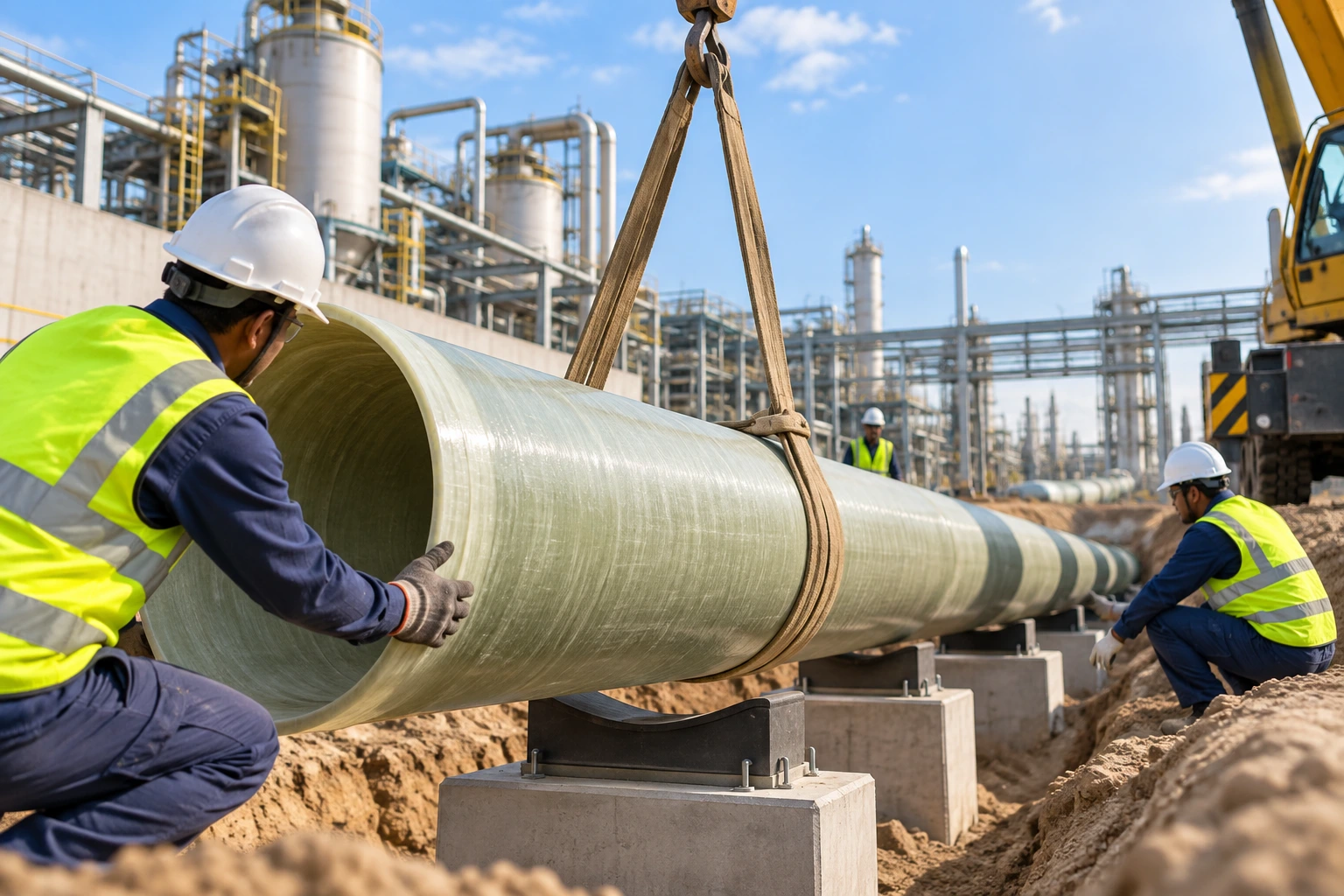
FRP Pipe Installation Guide for Industrial Projects
What makes an FRP pipe installation succeed on a real industrial site? Planning, correct handling, proper alignment, the right joint method, and testing before start-up. Skip any one of these, and good-quality pipe can still leak, crack, or fail early.
FRP pipe installation is the process of positioning, aligning, jointing, supporting, and testing fiberglass reinforced pipe used in industrial pipelines. FRP and GRP describe the same composite material, glass fiber set in a resin matrix, with naming that shifts by region and industry. Correct installation protects pressure performance, corrosion resistance, joint strength, and service life. Exact steps depend on pipe diameter, pressure rating, stiffness class, service fluid, and manufacturer instructions, so project drawings always come before general advice.
1. Plan Before Starting
Every FRP pipe installation starts on paper, not on site. Planning stops the costly rework that happens when a crew finds a mismatch between the pipe and the site halfway through a job.
Review project requirements:
- Pipe diameter, wall thickness, and pressure rating
- Stiffness class, temperature, and transported fluid
- Route: above-ground or buried
- Fitting and support locations
Check site conditions:
- Trench depth, soil type, and groundwater level
- Foundation and bedding material
- Access for lifting equipment
A short meeting between the engineer and the install crew, before work starts, catches most planning gaps early.
2. Inspect, Handle and Store Pipes Properly
Fiberglass pipe handles normal loads well but reacts badly to sharp impacts and point pressure. Damage during handling is one of the most common, and most avoidable, causes of early failure.
On arrival, inspect for:
- Cracks, chips, or scratches
- Pipe end and flange condition
- Correct fitting count
Handling and storage rules:
- Lift with padded slings, never chains
- Never drag pipe across the ground
- Store on level, full-length supports
- Block pipes to stop rolling
- Keep joint ends capped and covered
A pipe that looks fine after a rough truck ride can still carry hidden stress in the laminate, so this check matters as much as the final inspection before joining.
3. Prepare the Trench, Foundation and Supports
Buried and above-ground pipes need different groundwork, so treat them as separate tasks.
For buried pipe:
- Dig a trench with stable, even sides
- Lay clean, compactable bedding material
- Support the pipe continuously along its length
- Backfill in layers with controlled compaction
For above-ground pipe:
- Space saddle supports per the manufacturer’s span table
- Add guides and anchors only where the design calls for them
- Allow room for thermal expansion
- Avoid clamping supports too tightly
For industrial projects, FRP pipes and fittings should be selected and installed according to the system design and application requirements.
Point loading and poor bedding cause most long-term pipe deformation, so this stage deserves real attention.
4. Align and Position the Pipes
How should FRP pipes be aligned? They should follow the approved drawings and stay within the manufacturer’s tolerance for line, level, and joint gap, without being forced into place.
- Follow drawings for elevation and direction
- Check straightness before final joint assembly
- Never bend the pipe to close a gap
- Never use flange bolts to pull sections together
Forcing alignment adds hidden stress at joints and supports. That stress often shows up months later as a leak, not right away, which makes it hard to trace back to its real cause.
5. Choose the Correct Jointing Method
Jointing is where most FRP pipe installation problems begin, because a weak joint undoes good work everywhere else. Common methods include gasketed mechanical couplings, flanged connections, adhesive-bonded joints, and FRP and GRP pipe lamination.
Preparing any joint:
- Clean pipe ends and remove dust or moisture
- Inspect gaskets and sealing surfaces
- Confirm alignment one more time
Flanged connections:
- Keep flange faces parallel
- Tighten bolts gradually in a cross pattern
- Apply the torque value from the data sheet, not a guess
Bonded and laminated joints:
- Prepare the surface exactly as instructed
- Apply resin and reinforcement in the specified sequence
- Let the joint cure fully before handling
- Use trained, certified personnel
No single torque figure or cure time fits every GRP pipe installation, since values change by resin system and manufacturer, so the data sheet always overrules a generic number.
6. Support Valves and Equipment Correctly
FRP pipe is not built to carry the weight of valves, pumps, or other equipment. Each heavy part needs its own independent support, separate from the pipe.
- Support spacing matches the approved design
- Saddles use soft, elastomeric contact, not bare metal
- Valves and pumps sit on their own supports
- Thermal movement is accounted for at fixed points
ISO 14692-4:2017, the standard covering fabrication, installation, and operation of glass-reinforced plastics piping, recommends independent support for heavy valves so their weight never transfers onto the pipe wall (ISO, 2017).
7. Inspect Before Testing
A final walk-through before testing catches problems while they are still cheap to fix.
Before installation and testing, a detailed FRP quality inspection can help identify cracks, delamination, dimensional problems, surface defects, and missing documentation.
| Check | What to Verify |
| Pipe condition | No visible cracks or damage |
| Alignment | Correct line and elevation |
| Joints | Fully assembled and cured |
| Flanges | Parallel faces, correct bolting |
| Supports | Right type and spacing |
| Valves | Independently supported |
| Buried sections | Bedding and backfill complete |
8. Hydrostatic Testing and Commissioning
Testing confirms the installation is ready for service. Before testing, confirm every joint has cured, supports are fixed, and valves and vents are ready.
- Use calibrated pressure gauges
- Fill the line slowly and bleed out trapped air
- Raise pressure only to the level in the project specification
- Watch joints closely during the hold period
- Repair and retest any section that fails
- Flush the system before it enters service
There is no universal test pressure for FRP pipe. The correct figure always comes from the project’s design pressure and the manufacturer’s rating, not a fixed industry number.
Common Installation Mistakes to Avoid
| Mistake | Result |
| Forcing pipe alignment | Hidden stress at joints |
| Wrong support spacing | Sagging or vibration damage |
| Over-tightening flange bolts | Cracked flange faces |
| Poor joint preparation | Leaks or joint failure |
| Backfilling without bedding | Point loads, deformation |
| Testing before joints cure | Weak, failed joints |
FRP vs GRP Pipe Installation: Is There a Difference?
FRP and GRP pipe installation are close enough to be the same job in most cases, since both terms describe fiberglass-reinforced composite pipe. FRP is common wording in North America; GRP is common across Europe, the Middle East, and Asia. The real steps still depend on resin, reinforcement, joint design, and pressure class from the manufacturer, not on which term the project uses.
| Term | Common Meaning |
| FRP | Fiber/Fiberglass Reinforced Plastic |
| GRP | Glass Reinforced Plastic |
| Installation | Set by system design and manufacturer |
FRP Pipe Installation Checklist
- Review approved drawings and specifications
- Inspect pipes and fittings on arrival
- Prepare trench, bedding, or supports
- Position and align the pipe
- Install approved joints
- Fit supports, guides, and anchors
- Connect valves and equipment independently
- Inspect joints and supports
- Complete hydrostatic testing
- Record inspection and test results
The global FRP pipe market reached USD 4.35 billion in 2024, driven by demand for corrosion-resistant piping in oil, gas, water, and chemical projects (IMARC Group, 2024, imarcgroup.com). That scale shows why getting each step of this checklist right matters on real projects, not just on paper.
Frequently Asked Questions
What is FRP pipe installation?
It is the process of positioning, aligning, jointing, supporting, and pressure-testing fiberglass reinforced plastic pipe, following the manufacturer’s specifications and project drawings.
How is GRP pipe installed?
GRP pipe installation follows the same steps as FRP: inspection, alignment, jointing with couplings, flanges, or adhesive, correct supports, and hydrostatic testing before service.
What are the common FRP pipe jointing methods?
Gasketed mechanical couplings, flanged connections, adhesive-bonded joints, and laminated field joints. The right choice depends on pressure, fluid, and manufacturer system.
Can FRP pipes be installed underground?
Yes. A buried pipe needs a prepared trench, proper bedding, continuous support, and controlled backfill to avoid point loads and deformation.
How are FRP pipes supported above ground?
With saddle supports, guides, and anchors placed at spacing set by the manufacturer, allowing for thermal expansion at fixed points.
How are FRP pipes tested after installation?
With a hydrostatic test: calibrated gauges, a gradual pressure rise to the project specification, a hold period, and joint inspection.
What are common mistakes during FRP pipe installation?
Forcing alignment, wrong support spacing, over-tightened bolts, poor joint preparation, backfilling without bedding, and testing before joints fully cure.
Key Takeaways
Good planning comes before any pipe touches the trench. FRP pipe needs careful handling, since damage during transport causes problems later. Correct alignment and proper supports protect the system for its full service life. Jointing must follow the approved method for that pipe system. Buried lines need proper bedding, and heavy equipment should never rest its weight on the pipe. Manufacturer instructions and approved drawings should always guide the final call on any FRP piping project.
Al Ragheedh Fiber Glass Factory has supplied and supported FRP and GRP pipe systems for industrial projects across Jubail, Riyadh, Dammam, and the wider GCC since 2003. View our Google Business Profile to learn more about our location, services, and customer reviews.