
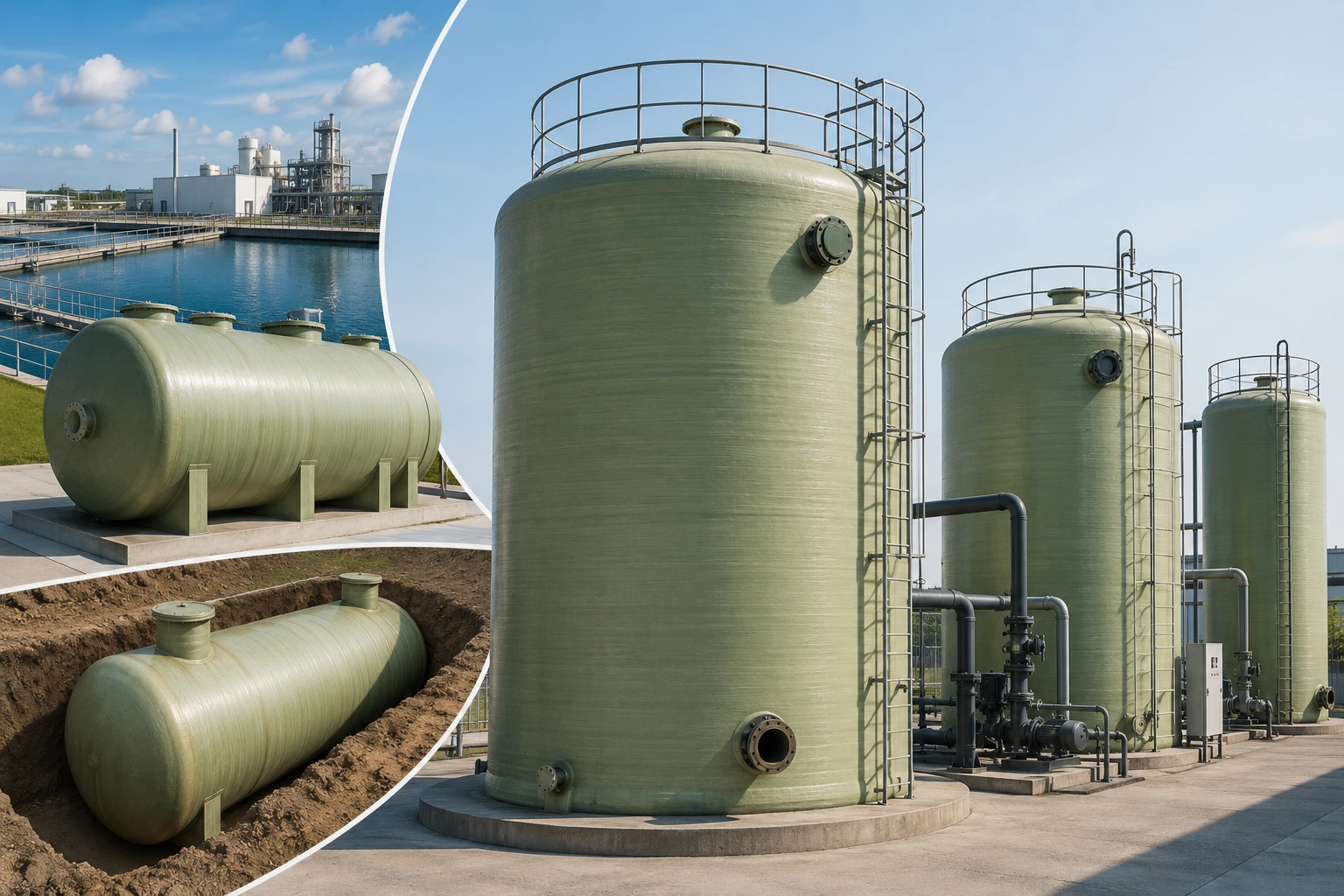
Complete Guide to FRP Tanks in Saudi Arabia (2026): Types, Uses, Benefits & Buying Guide
Quick Summary:
FRP tanks Saudi Arabia are widely used for storing water, chemicals, wastewater, and industrial liquids because they resist corrosion, last for decades, and require very little maintenance. This guide explains what FRP tanks are, their types, applications, benefits, manufacturing process, buying tips, Saudi standards, and the factors that affect pricing. Whether you are a project engineer, contractor, or procurement manager, this guide will help you choose the right FRP tank for your application.
Table of Contents
- What Are FRP Tanks?
- Why Saudi Arabia Needs FRP Tanks More Than Most Countries
- Types of FRP Tanks Available
- Where FRP Tanks Are Used Across Industries
- FRP vs GRP vs Steel vs HDPE – Side-by-Side Comparison
- Advantages of Choosing Fiberglass Tanks
- How an FRP Tank Is Built
- Tank Sizes and Capacities
- Buying Guide: How to Pick the Right Tank
- Saudi Standards and Certifications to Look For
- Installation and Maintenance Tips
- What Drives the Cost of FRP Tanks in Saudi Arabia
- Frequently Asked Questions
- Why Al Ragheedh Fiberglass Stands Apart
What Are FRP Tanks?
A steel tank rusts. A concrete tank cracks. An FRP tank just keeps going.
FRP stands for Fiberglass Reinforced Plastic. The tank body is built from layers of glass fiber woven together and locked in place with resin – either Polyester Resin, Vinyl Ester Resin, or Epoxy Resin, depending on what the tank will store. That layered construction is what gives FRP tanks their unusual combination of strength and lightness.
The glass fiber carries the load. The resin seals every surface, leaving no path for moisture, acid, or salt to get through. The outer shell is smooth, hard, and – when made correctly – completely sealed from top to bottom.
FRP tanks are also widely sold under the name GRP tanks (Glass Reinforced Plastic). Both terms describe the same product. The difference is geography – GRP is more common in Gulf markets and Europe.
Learn more about our FRP Storage Tanks designed for industrial, commercial, and municipal applications across Saudi Arabia.
Why Saudi Arabia Needs FRP Tanks More Than Most Countries
Steel has a short, unhappy life in Saudi Arabia.
Walk past any unprotected steel structure near the Arabian Gulf coast in Dammam or along the Red Sea in Jeddah. The salt air works fast. Within a few years, rust appears. Within a decade, the structure needs replacement.
Now think about industrial storage tanks sitting in Jubail Industrial City under direct sun, holding chemicals, reaching 60°C on the outer shell. Carbon Steel tanks under those conditions require constant repainting, anti-corrosion coating, and inspection. The maintenance costs never stop.
FRP tanks do not have that problem. They were designed for environments exactly like Saudi Arabia’s:
- No rust. Ever. Glass Fiber and resin do not oxidize.
- UV-resistant outer layers protect against Saudi Arabia’s intense year-round sun.
- Suitable for high-temperature service up to 120°C depending on resin type.
- Equally comfortable in coastal Yanbu Industrial City or dry inland Riyadh.
- Lighter than steel, so foundations, transport, and installation all cost less.
With Vision 2030 pushing massive growth in water infrastructure, industrial cities, and manufacturing, the demand for FRP tanks Saudi Arabia is rising every year.
Types of FRP Tanks Available
FRP Water Storage Tanks
Used in municipal water supply, Reverse Osmosis (RO) systems, and desalination plants. These tanks use food-safe resin approved for potable water storage.
Explore our FRP Water Tanks for safe and long-lasting potable water storage.
Chemical Storage Tanks
Built with Vinyl Ester Resin or Epoxy Resin to hold aggressive chemicals like Sulfuric Acid, Hydrochloric Acid, and Sodium Hydroxide safely. Resin selection must match the stored chemical.
View our Chemical Storage Tanks for safe storage of acids, alkalis, and industrial chemicals.
Underground FRP Tanks
Buried tanks for fuel or groundwater storage. Their resistance to soil moisture makes them significantly safer than buried steel, which corrodes from the outside.
Vertical FRP Tanks
The most widely used configuration. High capacity, small footprint, easy to stack accessories like level gauges and manways on top.
Horizontal FRP Tanks
Lower profile, stable center of gravity. Good for mobile installations and sites with height restrictions.
Custom FRP Tanks
Engineered to exact client specifications – specific diameters, pressure ratings, nozzle positions, and chemical linings. Common on major projects in Jubail and Yanbu.
Where FRP Tanks Are Used Across Industries
- Water Treatment: Holding tanks for RO permeate, desalination output, and wastewater treatment
- Oil & Gas: Chemical injection tanks and produced water storage on Saudi Aramco-linked projects
- Petrochemicals: Process tanks for SABIC operations and downstream chemical plants
- Chemical Manufacturing: Bulk storage of acids, alkalis, and solvents
- Food & Beverage: Ingredient storage in food-grade FRP tanks
- Agriculture: Irrigation water tanks across Saudi farmland
- Power Plants: Cooling water tanks and chemical dosing systems
- Mining: Slurry and acid leach tanks
We provide Industrial Fiberglass Solutions for industries including water treatment, petrochemicals, manufacturing, mining, and infrastructure projects.
FRP vs GRP vs Steel vs HDPE – Side-by-Side Comparison
| Feature | FRP / GRP | Carbon Steel | Stainless Steel | HDPE |
| Corrosion Resistance | Excellent | Poor | Good | Good |
| Weight | Light | Very Heavy | Heavy | Light |
| Lifespan | 25–50 years | 10–15 years | 20–30 years | 15–20 years |
| Maintenance Need | Very Low | High | Medium | Low |
| Chemical Resistance | Excellent | Poor | Medium | Good |
| UV Resistance | High (with coating) | Low | Medium | Medium |
| Installation Difficulty | Easy | Hard | Hard | Easy |
| Total Cost Over 20 Years | Low | Very High | High | Medium |
Advantages of Choosing Fiberglass Tanks
- No rust, no oxidation – no matter the stored liquid or environment
- Lifespan of 25 to 50 years beats every common alternative
- Up to 75% lighter than a steel tank of equal volume
- Seamless, leak-proof construction – no welded joints to fail
- Resin system chosen to match exact chemical exposure
- Low maintenance – no repainting, no anti-corrosion work
- Lower total cost across the tank’s full working life
How an FRP Tank Is Built
- Engineering design – wall thickness, nozzle positions, and pressure rating are calculated.
- Resin selection – Polyester for water; Vinyl Ester for chemicals; Epoxy for extreme service.
- Filament Winding – a CNC Winding Machine wraps continuous glass fiber strands saturated in resin at precise angles around a rotating steel mandrel.
- Hand Lay-Up – used for flanges, fittings, and non-cylindrical sections.
- Curing – the wound tank is heat-cured until the resin reaches full structural strength.
- Inspection – wall thickness, laminate quality, and dimensions are checked against the engineering drawing.
- Hydrostatic pressure test – the finished tank is water-tested at above working pressure before leaving the factory.
Tank Sizes and Capacities
| Volume | Typical Application |
| 500 L – 1,000 L | Small commercial sites, farms |
| 5,000 L | Building rooftop water storage |
| 10,000 L | Industrial process holding |
| 25,000 L | Water treatment, chemical bulk |
| 50,000 L | Municipal, large petrochemical |
| Custom | Major oil, gas, and SABIC projects |
Buying Guide: How to Pick the Right Tank
Getting this choice wrong costs serious money later. Work through these points before ordering:
- What liquid will it hold? Water, acid, fuel, and food all require different resin systems.
- How much do you need to store? Size the tank 20% above your peak requirement.
- What is the operating pressure? Order a tank rated above your maximum working pressure.
- Where will it be installed? Outdoors, underground, and indoor installations each have different requirements.
- What temperatures will it face? Confirm both process temperature and site ambient.
- What certifications does your project require? Check SASO, ASTM, and AWWA requirements before ordering.
Saudi Standards and Certifications to Look For
Before buying from any supplier, verify these:
- SASO – Saudi Standards, Metrology and Quality Organization approval
- Saudi Building Code – for structural applications
- ISO 9001 – confirms the manufacturer has a quality management system
- ASTM D3299 – filament wound tanks standard
- ASTM D4097 – contact-molded tanks standard
- AWWA C950 – fiberglass water tanks standard
Ask for test certificates in writing. A legitimate supplier will have them ready.
Installation and Maintenance Tips
Installation:
- Build a flat, reinforced concrete foundation sized for the full tank weight when loaded.
- Use padded lifting slings – never chains directly on the tank shell.
- Anchor horizontal tanks against wind movement.
- Underground tanks need sand bedding and careful compaction to avoid point loading.
Maintenance:
- Visual external inspection once a year.
- Interior cleaning every 2 to 3 years depending on stored product.
- Repair surface damage with compatible resin – do not leave cracks unattended.
- Keep heavy machinery away from installed tanks.
What Drives the Cost of FRP Tanks in Saudi Arabia
No honest supplier gives a price before knowing the specification. These factors move the number significantly:
- Tank volume – larger tanks cost more, but cost per litre drops at scale
- Resin grade – Vinyl Ester and Epoxy cost more than Polyester
- Pressure rating – higher pressure means thicker walls and more material
- Custom fittings – manholes, multiple nozzles, ladders, and level gauges all add cost
- Third-party certification – independent testing adds to project cost but protects the buyer
- Transport distance – delivery from Jubail to Riyadh or Jeddah adds logistics cost
- Site installation – foundation work and piping connections are separate from tank cost
Get a full technical specification written before requesting any quotation.
Why Al Ragheedh Fiberglass Stands Apart
Al Ragheedh Fiberglass Factory has been building fiberglass products in Saudi Arabia since 2003. That is more than two decades of manufacturing in the Kingdom – not as a distributor, but as an actual manufacturer based in Jubail.
The factory works directly with project engineers and procurement managers from the design stage. Every tank starts with a specification review. Wall thickness, resin selection, nozzle placement, pressure rating – all of this gets confirmed in writing before a single strand of glass fiber goes onto the mandrel.
Quality control is not a marketing line at Al Ragheedh. Every tank goes through laminate inspection, dimensional verification, and hydrostatic pressure testing before it leaves the factory floor. Certifications including ISO 9001 and ASTM compliance are not optional extras.
Al Ragheedh serves clients across Riyadh, Dammam, Jeddah, Jubail Industrial City, and Yanbu Industrial City – covering construction companies, industrial contractors, facility managers, and infrastructure developers. After-sales technical support is available for installation guidance, troubleshooting, and repair.
When you order from Al Ragheedh, you deal with the people who built your tank.
FAQ
What is an FRP tank?
An FRP tank is a storage vessel made from layers of Glass Fiber locked in resin. It stores water, chemicals, fuel, and food-grade liquids. It does not corrode, lasts 25 to 50 years, and needs very little maintenance compared to steel or concrete alternatives.
What is the difference between FRP and GRP?
Nothing – they are the same product. FRP (Fiberglass Reinforced Plastic) is the term used in North American markets. GRP (Glass Reinforced Plastic) is more common in the Gulf region and Europe. Same materials, same manufacturing process, same performance.
Which resin is best for chemical storage?
Vinyl Ester Resin handles most acids including Sulfuric Acid and Hydrochloric Acid. Epoxy Resin is chosen for the most aggressive applications. Polyester Resin works for water and mild chemicals. Always confirm chemical compatibility before ordering.
How long do fiberglass tanks last?
A well-built FRP tank lasts between 25 and 50 years. That range depends on what it stores, whether it sits outdoors, and how regularly it gets inspected. Tanks in managed industrial facilities regularly exceed 30 years of service.
Can FRP tanks store drinking water?
Yes, when built with food-safe resin that meets potable water standards. Confirm the resin system is approved and the tank meets AWWA C950 or equivalent SASO requirements.
Are FRP tanks suitable for desert climates?
FRP tanks were essentially made for conditions like Saudi Arabia’s. They handle temperatures up to 120°C, resist UV degradation when built with the right outer layer, and show no reaction to dry heat or dramatic daily temperature swings.
What industries use FRP tanks in Saudi Arabia?
Water treatment, oil & gas, petrochemicals, chemical manufacturing, food production, agriculture, power generation, and mining all use FRP tanks regularly across Saudi Arabia.
Can FRP tanks be installed underground?
Yes. Underground FRP tanks are common for fuel storage. They require proper engineering – sand bedding, correct backfill, and load rating for soil pressure and vehicle loads above.
How much maintenance do FRP tanks require?
Significantly less than steel. Annual visual inspection, interior cleaning every 2 to 3 years, and prompt patching of any surface damage. No painting, no anti-corrosion coating, no annual overhaul.
What certifications should I ask for?
ASTM D3299, ASTM D4097, AWWA C950, ISO 9001, and SASO compliance depending on your application and project requirements.
Conclusion
Steel tanks made sense once. In Saudi Arabia’s heat, salt air, and chemical-heavy industries, they have mostly been replaced by something better.
FRP tanks Saudi Arabia outperform steel on corrosion, outperform HDPE on strength, and outlast both on a 30-year horizon. Whether your project is a water treatment plant in Riyadh, a chemical storage facility in Jubail Industrial City, or an underground fuel tank in Yanbu, there is an FRP or GRP tank specification built for exactly that job.
The only real mistake is choosing a supplier based on price alone. Verify their certifications. Review their manufacturing process. Ask to see pressure test results. A good FRP tank is a 30-year investment – treat the buying decision accordingly.
Need help specifying the right tank for your project?
Contact Al Ragheedh Fiberglass for a no-obligation technical consultation.